
Thoughts from 30,000 feet

It’s 10pm on a Saturday night as I write this and I’m on a flight from London to Boston. I’m heading to the Marine Biological Laboratories in Woods Hole, Massachusetts where I will be spending the week teaching on an advanced study course, aimed at graduate students and post-docs in my field. I’ve participated in this course for the last five or so years and it’s something I’ve grown to look forward to every year [Link]. In part this is because I always find it stimulating and inspiring experience. Like all courses at Woods Hole it’s intense, the participants are always engaged and committed, they will pull all-nighters to work on their projects and then still want to ask questions and discuss details when you lecture the following morning.

On top of this, the other faculty who teach on the course are leaders in the field and spending a week with them catching up, discussing science, exchanging ideas is both motivating and enormously enjoyable. There’s something about the face to face social time that produces open discussion and leads to new ideas. The environment of Woods Hole is particularly good at encouraging this: we all stay in the same halls, eat together and spend most of our waking hours in each-others company. And because the course has a particular theme, it gives everyone a common focus. While electronic communication, whether email or Skype, is great for maintaining friendships and collaborations, it doesn’t come close to replacing this kind of interaction.

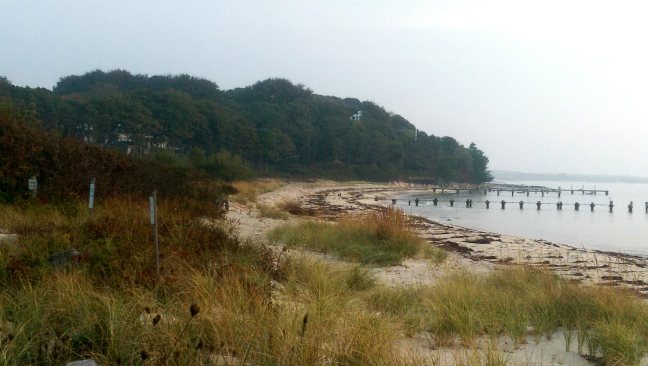
The other reason I look forward to returning to Woods Hole every year is because October is the perfect time to be visiting this part of the world. The summer season is over, the trees are on the turn and there’s a morning chill in the air. Many of the houses are holiday homes and these are shuttered for the winter, it all adds up to a dignified but austere look to the place.
imag1139_1

The trip reminds me what a great job I have that allows me to travel and see the world like this. It’s not the first or last trip I’ll make in a year that has taken me from India to LA and places in between. International travel wasn’t something I had realised would be a feature of a career in research. I hadn’t travelled much before leaving university and the opportunity to travel wasn’t mentioned when science careers were discussed in school – in fact I imagined a scientist’s career to be a lifetime spent in a lab working away in some corner of academe. Perhaps this has changed over my lifetime – today there seems to be a wider appreciation that research is an international endeavour. But I’m still not sure we highlight this aspect of research enough when we talk about career choices. This is a shame because it is something many people look for in a job and I can’t think of another career where it would have been so easy for me to visit so much of the world, live and work abroad and have friends and colleagues in so many places.

Of course there are downsides to this. The days of airline travel being glamorous, if they ever existed, are long gone. There are many evenings when I would happily swap a hotel room for the chance to spend the evening at home and in my own bed. And I know I would love for my best friends to live at the end of the road, rather than on another continent. But until we find a way of interacting with our fellow human beings that is as good as meeting them face to face, I am going to sit back, relax and look forward to spending a week in a beautiful part of the world.

The Three Billion Dollar Question

In the last few weeks, two technology companies have announced major investment in – and huge ambitions for- medical research. Microsoft hit the headlines with their proposal to “solve the problem of cancer” within ten years. Simultaneously the Chan-Zuckerberg foundation, led by the Facebook founder Mark Zuckerberg and his physician wife, Priscilla Chan, promised to invest $3 billion over ten years in basic research with the goal of helping cure, prevent and manage all diseases within their children’s lifetime. These are big, bold and ambitious goals – and seemingly large sums of money.

I’ve been reflecting on these announcements and what struck me was the amount of money being committed to these projects is similar to the research spend of my own institute, the Crick. The $3 billion pledged from the Chan- Zuckerberg foundation is certainly a headline grabbing number, but that amounts to $300m a year over the proposed ten years of the project. Compare that to our yearly budget of around £120 million, which equates to a little under $200 million per year, at current exchange rates. We too have an ambitious strategy [Read it here].

discoverywithoutboundaries

Our aims include supporting research that will advance biomedical knowledge and clinical practice but we haven’t committed to curing, preventing disease or eradicating cancer within a specific timeframe. Instead our strategy focuses on advancing knowledge, ensuring that new understanding is used to improve health and wealth, and training future generations of scientists to continue the process. So is our strategy too modest? By not promising to make the lame walk or revive the dead, are we setting our sights too low?

I don’t think so, because biology poses fundamentally different challenges from the ones engineers and technology companies are generally used to dealing with. Firstly, many health and medical problems are not simply about the lack of a technical, therapeutic solutions. Many are inextricably linked to economic and societal problems. At their root is often poverty and disadvantage. In the developing world this is perhaps most obvious. Modern drugs are expensive, often involve extended courses of treatment, preventative measures require concerted government action, vaccines need refrigeration and so on. These are difficult to provide in poor countries where government and public institutions are weak. In rich countries, inequalities in wealth result in health problems concentrating in disadvantaged sectors of society. Smoking and obesity rates, major contributors to poor health, are highest in lower income groups resulting in a striking gradient of life expectancy, with the richer living substantially longer and in better health than the poorer. Investing in medical research won’t change this.

Secondly, biology has the habit of fighting against anything we try to do. Twenty years ago, when I was a graduate student, there was much excitement about designer drugs, principally kinase inhibitors, directly targeting the cause of specific cancers. There has certainly been significant progress in this area and notable successes. But in many cases these only provide limited periods of remission before evading mutations arise, allowing the tumour to resume its relentless course. Indeed studying the effect of these natural selection-like events in tumours has become a fruitful research field and new understanding has the potential to offer insight into how to design better therapeutic regimes. Likewise, the rise of antimicrobial resistance offers a salutary lesson on how evolution can make powerless previously potent therapies. These examples, and many more, mean that the biomedical researchers have learnt to respect the ability of biology to confound even our smartest and most dedicated efforts. Natural selection is a powerful and inescapable force, it is insidious and inexorable. This may be difficult to appreciate if you come from an engineering field where technology has progressed amazingly rapidly, and where any problem encountered can be overcome with imagination and enough computing power. However, technology problems tend not to fight back. In biological systems, evolution generates feedback that leads to complexity, resulting in the whole being greater, and much more difficult to understand, than the sum of the parts. Problems are never permanently solved. At best you win the battle and learn to fight the next one a little better.