As an Editor of the journal Development, I often hear complaints about peer review. We all know the problems – from lengthy review times to requests for seemingly unnecessary experiments. I agree with many of these complaints. Katherine Brown (Executive Editor of Development) and I recently wrote an editorial about this in which we talk about some of the things Development is doing to mitigate the worst of the problems.
But writing this editorial made we reflect on the positives of peer review. Despite the well-documented problems, I think peer review serves an invaluable role, but one that is often under appreciated.
There have been calls to abandon peer review in favour of simply posting preprints. But while I’m in favour of preprints – I think they accelerate the dissemination of scientific knowledge and reduce some of the gratuitous gatekeeping activity that peer review can generate – I believe that relying solely on preprints would ignore the fundamental role that peer review plays in scientific discourse and the building of fields.
Peer review serves as more than just a gateway to publication – it actively shapes the standards, methods, and theoretical frameworks that define scientific fields. When reviewers evaluate manuscripts, they engage in a dialogue with authors and editors about what constitutes sufficient evidence for specific claims, which questions are of interest, and how new findings integrate with established knowledge. It is this dialogue that creates and maintains coherent scientific fields.
This scientific dialogue begins even before manuscript submission. As authors, we write our papers with peer review in mind, anticipating questions, criticisms and potential alternative interpretations. Anticipating peer review helps maintain consistent standards across a field and ensures that new work engages with and builds meaningfully on existing foundations. The peer review process creates a shared understanding of what constitutes valid experimental design, appropriate controls, and reasonable conclusions within specific research fields.
Arguably, facilitating peer review is the most important contribution journals make to scientific progress. Without this structured evaluation system, scientific fields risk fragmentation. In a purely preprint-based world, where papers are posted without the expectation of peer review, the collective standards that bind research communities together could erode. Different research groups might adopt diverging methodological approaches or make claims based on varying levels of evidence, making it increasingly difficult to compare and build upon each other’s work. This fragmentation would ultimately impede scientific progress by compromising the ability of researchers to effectively communicate and collaborate.
Peer review also plays a crucial role in maintaining the integrity of scientific fields over time. Through evaluation of new papers, reviewers help ensure that published work meets established standards while remaining open to innovative approaches and challenging findings. This balance between conservation and progress allows fields to evolve systematically, incorporating new discoveries without losing the foundation of previous work.
The process also serves an important educational function, helping train new generations of scientists in field-specific standards and practices. Through receiving and responding to reviewer feedback, researchers develop a deeper understanding of their field’s methodological requirements and theoretical frameworks. This training aspect of peer review helps maintain consistency and quality across generations of scientists.
While we should certainly strive to improve the peer review process, its fundamental role in maintaining scientific fields and facilitating progress should not be underestimated. Rather than abandoning peer review, we should continue working to enhance its efficiency and fairness while preserving its essential function as a cornerstone of scientific dialogue. The future of scientific progress depends not just on new discoveries, but on maintaining the coherent, collaborative framework that peer review helps to provide. Science isn’t only individual discoveries – it’s about building something bigger together and peer review is an important component of the glue that binds us together.
Recently, I had the privilege of attending “Like a rolling marble: Waddington’s landscape vibrant legacy and beyond” a fascinating workshop, held in Lyon, that brought together mathematicians, biologists, physicists, and philosophers of science. The discussions highlighted how Waddington’s epigenetic landscape, conceived almost a century ago, continues to beguile and influence modern biology. I was struck by both the enduring power of Waddington’s metaphor and how it has been co-opted by different generations of scientists in different fields. This workshop took place just a few weeks after I got back from teaching at MBL, Woods Hole, where I was part of the Gene Regulatory Networks for Development course. Comparing those two experiences got me thinking about how, in the era of single cell high-throughput analysis, we can apply Waddington’s insights and Eric Davidson’s work on gene regulatory networks.
Cell fate specification remains a central problem of developmental biology. How is cell diversity produced during development and how is the process organised in space and time? I would argue that two of the most influential frameworks that have shaped our understanding are Conrad Waddington’s epigenetic landscape and Eric Davidson’s gene regulatory networks (GRNs). While these perspectives can be presented as distinct approaches, they share a fundamental characteristic that, in my view, does not receive sufficient attention – they are inherently dynamic.
Waddington’s Landscape: More Than Just Hills and Valleys
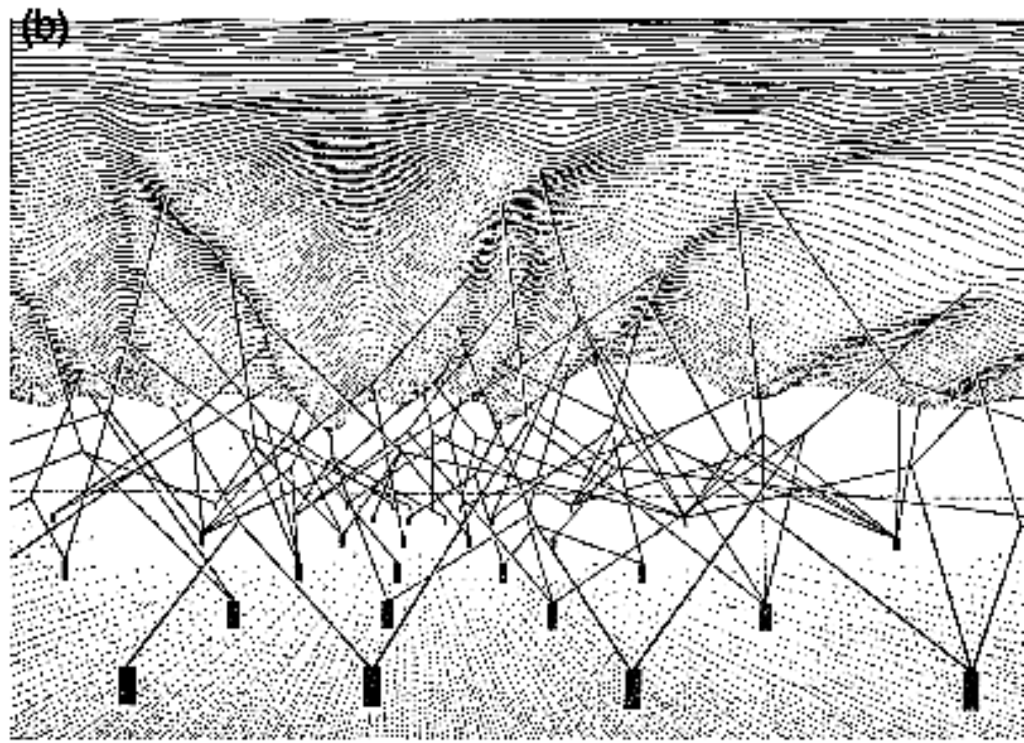
Waddington’s Classical Epigenetic Landscape From Strategy of the Genes, 1957
Waddington’s epigenetic landscape, proposed in “The Strategy of the Genes” (1957), has proven remarkably versatile as a conceptual framework. The metaphor of a ball rolling down a landscape of hills and valleys has been adapted to explain various biological phenomena, from molecular mechanisms of differentiation to broader evolutionary concepts such as genetic assimilation. It’s ubiquity has meant it has become a cliche with its flexibility being both a strength and a source of misunderstanding.
Underneath the epigenetic landscape: the shape of the landscape is determined by tension guy-ropes. From Strategy of the Genes, 1957
The landscape metaphor has often been reduced to static snapshots – fixed topographical maps of cell fate choices. However, Waddington himself indicated the dynamic nature of his concept. The landscape isn’t a fixed terrain. It is shaped by genetic interactions. Waddington visualised these as a network of guy-ropes pulling the landscape from below, creating and modifying the contours of the landscape. From our 21st Century viewpoint, we can view the molecular and mechanical cues that cells receive as they develop as the inputs adjusting the ropes to modify the landscape.
Waddington’s landscape metaphor found mathematical grounding in dynamical systems and bifurcation theory. Indeed in the 1960s, Waddington corresponded with René Thom, the pioneer of catastrophe theory. This connection revealed deep links between the qualitative behaviour indicated by Waddington’s landscape systems and the geometric approach to dynamical systems. In the language of dynamical systems theory, Waddington’s landscape can be understood as a potential function, the local minima of which represent stable cell states, with the paths between these states corresponding to unstable manifolds connected by bifurcation events. This mathematical interpretation helps explain how continuous changes in cell state can lead to discrete cell fate decisions, and how developmental robustness emerges from the topology of the state space. The mathematical formalisation of Waddington’s ideas through dynamical systems theory provides a rigorous framework for understanding how molecular mechanism generates the landscape’s features and how cells navigate this ever-changing terrain. (For more discussion on dynamical systems and landscapes see <https://pubmed.ncbi.nlm.nih.gov/35860004/>.)
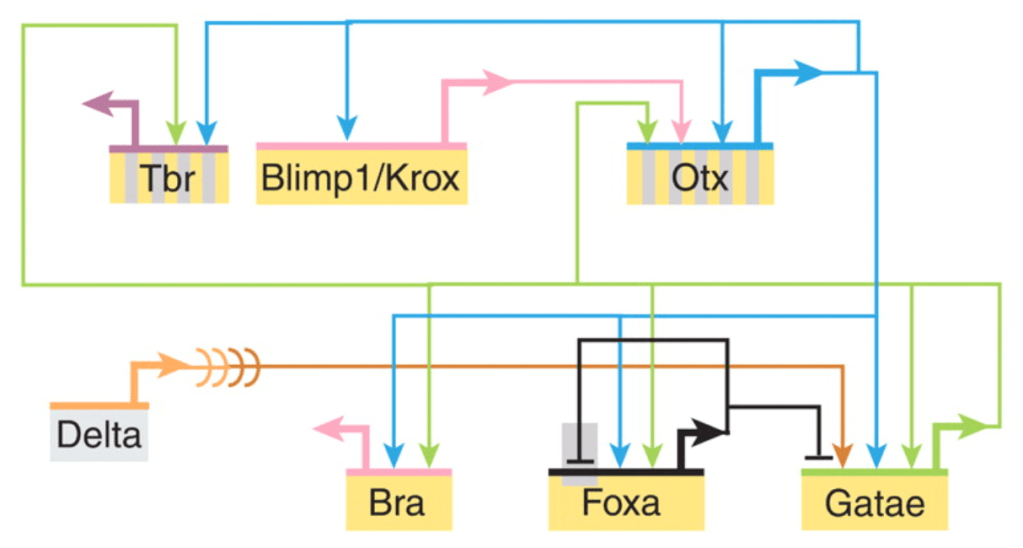
A Gene Regulatory Network from Davidson and Erwin, Science 311, 796-800
Complementing the Waddington Landscape, Eric Davidson’s work on gene regulatory networks offers a molecular framework for understanding cell fate specification. The GRN theory he developed, inspired by his detailed studies of sea urchin development, revealed the complex hierarchical organisation of transcription factors and signals that drive cell fate decisions. And placed these in an evolutionary context. However, like Waddington’s landscape, GRNs are sometimes misinterpreted as static wiring diagrams.
GRNs are dynamic systems operating in time and space. The networks Davidson described were complex systems with temporal progression, feedback loops, and state-dependent behaviours. Each node in a GRN represents not just a gene, but a dynamic entity the activity of which changes over time, in response to the system’s state. Davidson articulated this through the concept of “regulatory states” – the combination of transcription factors present in a cell at a given time that determines its developmental trajectory. These regulatory states progress through distinct phases during development, with early states setting up the conditions for later ones in a precise temporal sequence. This progression is driven by both positive feedforward circuits that drive cell fate decisions and negative feedback loops that refine and stabilise gene expression patterns. The time delays inherent in transcription, translation, and protein degradation create a system where the timing of regulatory events is just as crucial as their connectivity.
The dynamics of the process are captured within GRN theory by the two complementary perspectives: the “view from the nucleus” and the “view from the genome.” The view from the nucleus considers how the cell interprets its current regulatory state to determine its next actions. At any given moment, the nucleus contains a specific combination of transcription factors that interact with enhancers and promoters to control gene expression. By contrast, the view from the genome considers how regulatory DNA sequences integrate various inputs over time to create specific developmental outcomes. This perspective reveals how the genome encodes not just the components of the network, but also the logic of developmental decisions through the organisation of cis-regulatory elements. These elements serve as information processing units, integrating multiple inputs to produce appropriate outputs in the correct spatial and temporal context. The interplay between these two perspectives – the dynamic state of the nucleus and the hardwired logic of the genome – creates a system that is robust and flexible. It is capable of producing reliable developmental outcomes by responding to external cues.
The Challenge of Single Cell Transcriptomics
The advent of single-cell transcriptomics has revolutionised our ability to study cell fate specification. Results from these experiments have been coerced into interpretations and models that are inspired by Waddington’s and Davidson’s theories. However, single cell transcriptomics predominantly captures static snapshots of cellular states. Although powerful computational methods attempt to infer developmental trajectories from these data, they inherently lack direct evidence of the causal relationships and dynamic processes that both Waddington and Davidson recognised as crucial.
This limitation has led to a somewhat paradoxical situation: we have more data than ever about cell states, yet we are losing sight of the dynamic nature of cell fate specification. Attempts to reconstruct GRNs from single-cell RNA sequencing data often result in static network models that, while useful for generating hypotheses, often fail to capture the temporal and causal aspects essential for understanding development.
To really understand cell fate specification, we need to reconcile the dynamic insights of both Waddington and Davidson with modern experimental approaches. I would argue that we need several complementary advances in both experimental and computational biology. First and foremost, we need new experimental techniques that can capture and test temporal dynamics at single-cell resolution. While current single-cell methods provide unprecedented detail about cellular states, they typically require cell destruction for analysis, making it impossible to track individual cells over time. Technologies such as metabolic labelling, live-cell imaging combined with endogenous reporters, or methods for recording cellular histories in DNA, show promise in filling this gap. (Here’s one of our attempts <https://pubmed.ncbi.nlm.nih.gov/38754365/>.) These approaches could help reconstruct the actual trajectories cells follow, rather than inferring them from population snapshots.
Alongside new experimental methods, we need computational frameworks specifically designed to handle and interpret temporal data in developmental contexts. Current analytical approaches often treat time as just another dimension in a high-dimensional space, but development is fundamentally a directed process with causality and irreversibility, and has arisen from an evolutionary process. New computational methods are needed that account for these features. Incorporating principles from dynamical systems theory or developing new mathematical frameworks that can handle the unique characteristics of developmental processes is required.
The challenge of understanding cellular decision-making also demands the integration of multiple types of data. Single-cell transcriptomics alone, while powerful, cannot reveal the full picture of development. We need to combine transcriptomic data with information about chromatin accessibility, protein levels, metabolic states, and cellular morphology – all while maintaining temporal resolution. This multi-modal approach would help reveal the causal relationships that drive cell fate decisions, moving beyond the correlative insights that dominate current analyses.
Finally, and perhaps most fundamentally, we need to acknowledge and incorporate into analytical methods development’s dynamic nature when interpreting static data. This means being explicit about the limitations of snapshot data and avoiding over-interpretation of apparent trajectories inferred from static samples. It also means developing new ways to validate our interpretations, through perturbation or constructionist approaches that test predicted causal relationships. This shift in mindset – from viewing development as a series of discrete states to understanding it as a continuous, dynamic process – needs to inform both our experimental design and our data interpretation.
The Way Forward
Both Waddington’s landscape and Davidson’s GRNs were conceived as dynamic frameworks for understanding development. As we develop increasingly powerful molecular tools, we must not lose touch with this fundamental insight. The challenge lies not just in generating more data, but in developing approaches that can capture and interpret the dynamic nature of cell fate specification.
The static interpretation of these inherently dynamic concepts has led to an oversimplified view of development. Modern single-cell analysis will benefit from a stronger theoretical foundation rooted in dynamical systems theory. Just as Waddington’s correspondence with Thom helped bridge metaphor and mathematics, we need new theoretical frameworks that connect the vast amounts of single-cell transcriptome data to the underlying dynamics of cell fate decisions. This might involve developing new mathematical tools that infer vector fields and potential landscapes from sparse, high-dimensional data, while accounting for the inherent stochasticity of biological systems. Such theoretical advances, combined with new experimental approaches, could help fulfil the promise of single-cell analysis to reveal the true dynamics of development.
At the end of 2016 the lab moved from the MRC-National Institute for Medical Research buildings in Mill Hill, London to the new Francis Crick Institute on Midland Road in Kings Cross, London. About six months before the move and six months after the move we documented a typical day in the lab.
Mill Hill Lab Door
Mill Hill Stairs
Mill Hill Corridor
Mill Hill Office
MNs in vitro
Mill Hill Tissue Culture
Mill Hill Labcoats
Mill Hill Embryo Dissection
Neural Crest Emigrating
Mill Hill Office
Mill Hill White Board
Mill Hill Microscope
Mill Hill Lab
Phase Space
Mill Hill Coffee
Mill Hill Coffee
Mill Hill Coffee
Mill Hill Attic Lab
Midland Road Lab
Midland Road Stairs
Midland Road Corridor
Midland Road Lab
Dorsal Ventral Patterning
Midland Road Labcoats
Single Molecule FISH
Midland Road Lab
Midland Road Microscope
In vitro differentiation
Midland Road Tissue Culture
Mathematica Screenshot
Midland Road Coffee
Midland Road Coffee
Midland Road Coffee
The Francis Crick Institute
[Photographs by Tony Briscoe | Scientific images by lab members]
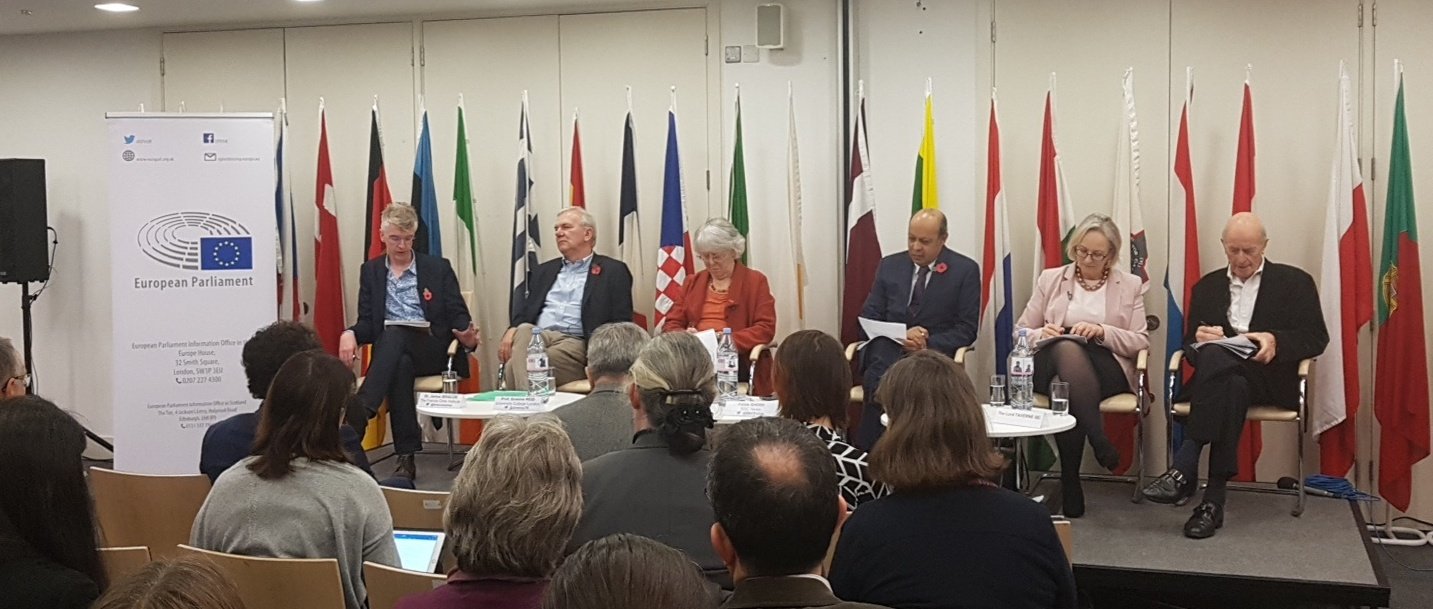
Since June 23rd 2016, the date of the EU referendum in the UK, we’ve been living in the shadow of Brexit. Similar to most scientists I was, and remain, deeply disappointed with the result and I am worried about the effect it will have on the UK. Almost 18 months on from the vote we still have very little detail about what the outcome means but the extent of the damage is gradually becoming apparent. I was prompted to reflect on this recently when I was asked to participate in a public discussion, hosted by the European Parliament Office in London
We were asked to explore the consequences of Brexit for science and research and the audience comprised science journalists, policy officers from learned societies, sociology academics and a couple of science attachés from European embassies. The event gave me an opportunity to collect my thoughts and present them to this group of people. Here are my notes.
Discussion panel at European Parliament in the UK
I’m a research scientist at the Francis Crick Institute and I’m very grateful for this opportunity to give the perspective of a research scientist. I lead a team interested in how the central nervous system – the brain and spinal cord – are formed before birth. This is revealing fundamental aspects of how a fertilised egg transforms into an individual. It also has implications for conditions such as spina bifida and spinal cord injury and diseases such as motor neuron disease.
My team comprises 16 scientists from a variety of disciplines: biologists, physicists, computer scientists. Three are from the UK, 10 have other EU nationalities and 3 are from outside the EU.
Our work is funded by a variety of sources. Including UK agencies such as the MRC and BBSRC, charities such as the Wellcome trust. But a substantial amount of funding is international. I have a European Research Council Grant worth ~£2M over five years and also collaborative grants with European colleagues and with US colleagues.
My situation reflects the broader position at The Francis Crick Institute. The Crick is a biomedical discovery institute dedicated to understanding the fundamental biology underlying health and disease. We address the big questions and the big health challenges – cancer, heart disease, dementia, birth defects, infectious diseases…
44% of our researchers are EU nationals from outside of the UK. We have just completed the recruitment of new research group leaders. Half of the applications came from EU/EEA citizens and the three candidates we recruited were all Europeans – Swedish, Spanish and Portuguese. In addition, the institute received about £5 million from EU funding last year to support our research.
I have three concerns about the consequence of Brexit for science and research. I call these the three P’s:
People, Participation and Perception.
People:
The strength of UK’s research rests on recruiting and retaining the very best scientists, whatever country they come from. Tightening immigration rules or introducing barriers is likely to be detrimental. Science is international and relies on the friction free movement of people and ideas.
Participation:
By contributing to EU programmes and collaborations – such as the ERC – we not only receive funding but also gain sway over the direction of research and we acquire prestige and recognition that boosts the UK. Full participation in international collaborations, advisory boards and committees allows the UK to influence the themes of research and allocation of funding.
Perception:
The message being heard outside the UK – by colleagues from in the EU but also the rest of the world – is that the UK is no longer an open, progressive and supportive environment for science. We appear to our colleagues and partners to be turning our backs on the world. This is wider than the EU – I’ve had questions from colleagues from Singapore to Los Angeles. The world is asking what will happen when the UK leaves the EU; what will be the affect on funding and the right to live and work in the UK.
Particularly problematic is the continuing uncertainty about the future of EU citizens in the UK is harming research now.
So my worry is that Brexit is taking the P’s out of UK science.
With this pessimistic analysis, what can the government do to mitigate the damage. The government has been saying the right things, but words are not enough. It is far from clear that Brexit won’t introduce barriers to the ready transfer of ideas, skills and people on which the best science relies. These might be unintended but devastating none the less.
First, we need immediate clarity on the rights of EU citizens and their dependents living and working in the UK.
Second, we need to establish rules for the free movement of students, scientists and their families.
Finally, we should commit to fully participate in future EU research programmes and facilities.
Bearing in mind the European Parliament will have a vote on the final Brexit deal, MEPs have an important role to play. I would like to see MEPs championing the case for science and research across the EU and the UK. Details such as the regulation of clinical trials and drug licensing must be in the Brexit agreement and most importantly we must maintain a collaborative and open environment for research.
The questions and challenges we face are universal and do not respect national borders. The answers that science can provide have the potential to benefit us all. But it requires international collaboration and cooperation. Friction free movement of people and ideas has the best chance of finding these answers. I firmly believe that no Brexit and reversing the course we are on is the best option for the UK and the EU but above all, let’s make sure that science and research are not an unintended casualty of Brexit.
It has now been around six weeks since my lab move – about the right time to reflect and form some first impressions. The move of the lab itself went much more smoothly than I was anticipating. This was in large part down to the team spirit and hard work of lab members preparing for the move. It turns out that packing up a lab in a institute that’s closing is great for team building and camaraderie. In addition, the efficiency and professionalism of the moving company meant that each of our boxes was delivered to the right bench in the new building almost without mistake, easing the process of unpacking. We were also fortunate that our move was at the end of the whole transition period. Many of the snags and quirks encountered by labs that had moved earlier than us had been ironed out by the time we moved. As a consequence, we were able to restart lab work within days of the move and now, six weeks in, it feels as if we’re almost back to normal. I hope I haven’t spoken too soon – there’s always the possibility something will go wrong – but so far so good.
The lab – up and running in Midland Road
One of the oddities of research is that whether someone moves buildings, organisations, or countries, the research stays the same. We’d be doing the same experiments and asking the same questions wherever we were. This provides a sense of familiarity and security, despite the change in surroundings. We’ve definitely appreciated this since our new environment is very different from what we were used to. In Mill Hill, my lab was split between several relatively small rooms, located on different floors, in a building that had both the charm and flaws of pre-WWII architecture. There was a warmth and sense of history to the building, but, lack of air conditioning meant the summers could be stifling and if the wind blew in the wrong direction when it rained, the windows leaked. These are problems we don’t have in Midland Road. The scale and modernity of the building could hardly be a greater contrast to our old accommodation. Nevertheless, I’ve been pleasantly surprised that it hasn’t felt intimidating or unmanageable. I think the general sense of goodwill amongst our colleagues and the feeling that we’re all going through this together has helped us settle in.
On the other hand, the increased size of the institute – almost double the number of scientists we were used to at Mill Hill – is very noticeable. One result is that there are almost twice the number of seminars, with many more internal talks. As well the developmental biology, immunology, neuroscience we’re used to, we’re being exposed to new topics ranging from cancer genomics to the yeast cell cycle. Adding to this, we’re in the middle of a recruiting new group leaders and so there 2-3 job seminars a week at the moment too. All of this is very stimulating and informative, but the number of hours in the day hasn’t doubled. I still need to find the time to do my job and not spend the whole day sitting in the auditorium, trying to get the right balance is a challenge. I still need to work out which are the most useful seminar series to attend and which of the internal meetings I skip without consequence. This will take me a few more months.
Another change I’ve noticed is the effect that the location of my office has. In Mill Hill my office was in the corner of my main lab. This meant that several times a day I walked through the lab, seeing people as they worked at the bench or at their desks. In addition, the door to my office was normally open so I would often hear and join in conversations. I had a good sense of what was happening in the lab – or at least I thought I did. And sometimes the spontaneous conversations that resulted led to new ideas, clarified existing questions or solved a problem. It also meant I was an obvious part of the lab, connected to and participating in its daily life. The arrangement in Midland Road is different. The desks are now located adjacent to, but outside, the labs and although my office is only a few metres down the corridor, it is separate. This means I’m no longer as in touch with the day-to-day detail of life in the lab as I was before. I’m beginning to miss the involvement. I no longer know when someone has an interesting or unexpected result and I don’t hear about the little difficulties someone might be having getting a thing to work. The weekly group meetings and individual meetings keep me in touch with progress and allow me to contribute ideas and suggestions but it’s not the same as hearing it in real time unfolding in the lab. I have a feeling that this will have a major effect on the dynamics of interactions within the group. I’ll be watching this with interest, because, although I might feel left out, the new arrangement might be disinhibiting for the rest of the lab. I’m also wondering whether there are different ways to have the informal and productive interactions that I’m beginning to miss and whether other group leaders have similar thoughts to me.
It’s done. My lab has moved from our old site in Mill Hill into the brand new Francis Crick Institute, Midland Road, opposite St Pancras Station. My lab’s move also happened to complete the main phase of the migration into the new building. A process that started, almost to the day, six months ago. During the last half year, more than 1500 people from four sites spread around London have moved to Midland Road. Now all the research labs, support services, core facilities and administration have moved and we’re all located under a single brand-new roof in central London. This doesn’t mean that the transition is entirely finished, there is still some work going on at the old sites and it will be another few months until they are handed over to their new owners. But our Mill Hill passes were officially deactivated on December 23rd and emphasis is now shifting from migration and on to getting everything running normally again.
Before and After
My lab’s move was both easier and more difficult than I was anticipating. As we were one of the last to move we benefited from watching everyone else move before us. This meant we knew what to expect and we were better prepared than some of the early movers. The major breakdown and pack-up of our Mill Hill lab was finished over an intensive few days. Everyone in the lab pitched in and it was more enjoyable than I thought it would be. It turned out to be a good exercise in building team spirit and allowed the organisation and motivational skills of several lab members to shine. The move company expertly and professionally handled the move itself and all of our equipment arrived on time, and mostly in the right place. Although microscopes are still being installed and tissue culture incubators commissioned, we were able to start molecular biology experiments within a week and activity was beginning to return to normal – before being interrupted for Christmas. All in all, it went more smoothly than I was expecting and resulted in a feeling of solidarity and goodwill within the lab.
What was more difficult and unexpected were the emotions associated with leaving Mill Hill. Being in the last phase of the move meant that most labs had left several weeks before us. The feeling of a building in decline and an awareness of an end of an era was very apparent. Having been in Mill Hill for sixteen years and knowing the history of the scientists and discoveries associated with the building, it was hard not feel a sense of loss on leaving for the last time. It’s also difficult not to worry whether our new home will be as supportive and good for us as Mill Hill has been. It’s still too early to tell what working in Midland Road will really be like and how well we will fit in. So despite the excitement about the new facilities, new colleagues and new opportunities, there is uncertainty about the future and the sentimentality for what used to be.
Fittingly, setting up the new lab coincides with the New Year, a good opportunity for new starts and turning over a new leaf. I’m looking forward to participating in and watching my lab as it re-establishes itself and settles in to the new environment. It will be interesting to see what stays the same and what changes – as a biologist interested in ideas from engineering, I see this as a good opportunity to test which features are robust to environmental perturbations and which are sensitive. More broadly, I’m curious to see how all the labs and facilities settle into the new building and how the culture and character of the institute reconfigures itself over the next months and years. The coming together of the groups from the two founding institutes – MRC-National Institute for Medical Research and the London Research Institute of CRUK – will make an interesting case study of how institutes merge and develop new scientific cultures. Not only that, but during the many years of planning for the Crick, detailed concepts and ideas were developed both for the design of the physical architecture of the building and also for how the institute will be organised and operated. I’m looking forward to seeing what works, what doesn’t; where we got things right and what we got wrong. As the military maxim goes, no plan survivesfirst contact with the enemy. I’m already intrigued to see how the labs that moved in a few months ago are adapting and altering spaces that the architects and builders left in pristine, clinical perfection. Some of the alterations are for practical reasons to make their science work but much of it reflects individual personalities and the desire of the occupants to make the labs their own. We’ll see how this extends to other aspects of institute culture and operation over the coming months and years. I’ll try to find the time to report my observations….
Oh and by the way, please note my new address: 1 Midland Road, London, NW1 1AT
It’s now only a couple of weeks until my lab moves from our building in Mill Hill to the new Crick Institute on Midland Road. Over the last 4-5 months almost all of my colleagues have completed their moves and my group is left almost alone in the old NIMR building. The corridors, that were once full of people from early in the morning until late at night, feel cold and bare; at lunchtimes there’s just a handful of people in the canteen; and labs that used to be full of equipment are empty and deserted. Most significantly, the staff bar (fondly remembered by several generations of Mill Hill scientists) is no longer open. In many ways, being in the institute as it has emptied out and closed down will make leaving easier. There are few things more melancholy then watching the slow demise of a once bustling building and with this happening as autumn sets in and winter approaches it only accentuates the sense of an end of era.
South from the roof of NIMR
The last few weeks have trigger some bouts of nostalgia and reminiscences. There are many things I will miss about Mill Hill. Looking out of the windows of my lab (on the top floor of the institute) we have spectacular views across North London. Looking South you can see the City and Canary Wharf. In recent years the Shard and the Walkie Talkie tower have become new features on the skyline. In the other direction, looking West, there is Wembley and in the far distance Heathrow. Our position, perched high on a hill, makes it one of the best spots in London to see fireworks. On Bonfire night we could climb out the windows to stand on the roof (which we would never do of course, since it was against safety rules) and see a panorama of half-a-dozen displays spread out before us, from the large professional one at Alexander Palace to the back garden and local sports club variety.
But what I remember most is the people that have been through the lab. There’s a well-known quote that you can never step in same river twice. Research labs definitely exemplify this. Students, post-docs, and often times research assistants too, come and go, only staying for a few years before moving on. If I think about the current members of my group, all have been in my lab less than 5 years and most have only 1 or 2 years experience of Mill Hill. As people leave the lab to further their careers, new members join. This means the lab is always in a dynamic equilibrium of constantly changing people, a situation that seems entirely fitting for a group studying biology. The continually varying makeup of labs has a significant effect on the culture of the work environment. Friends of mine who have successful careers in more conventional organisations get promoted into increasingly senior positions. On a day-to-day basis they mostly interact with people in the layers of organisation just above and below them in seniority. More often than not these people are of fairly similar ages and experience and increase as their careers progress. By contrast in a research lab, although I get older, most of the people in my group remain in their 20s and 30s. It makes for a refreshing and lively experience but I do wonder whether it puts me at risk of Peter Pan Syndrome, never really growing up.
A satisfying consequence of the constant turnover of people in the lab is that there is a diaspora of past lab-members spread across the world. From Japan to America, in faculty positions, post-docs or other professions ranging from journal editor to tech transfer manager there’s a growing number of people that have passed through the lab. Although I see and communicate regularly with many of them, my memories of most remain associated with Mill Hill and their time in the lab. I can recall specific discussions or particularly important lab meetings and I often think of a certain bench or desk as belonging to a certain person for a long time after they’ve left and someone new is occupying it. Our move out of Mill Hill will break these links and it will be a sad day for me when I finally leave. As Peter Pan said, “Never say goodbye because goodbye means going away and going away means forgetting.”
This week is a big week at The Crick. We have the official opening ceremony on Wednesday at which our new building will be shown off to visiting royals, dignitaries and the press. Then on Thursday, at midnight, applications close in our first round of group leader recruitment. Although this will happen with less pomp and pageantry then the festivities on Wednesday it is, to many of us, a much more significant event. Buildings – the laboratories, offices and facilities – are of course important for an institute. I’ve written in a previous blog about the thinking and effort that went to the design of our new building and I’m eager to move in. But, in the end, research institutes are people, not bricks and mortar. No matter how fancy or sophisticated a building, what determines whether an institute is a success or failure is the researchers who occupy it.
That’s why I’m more excited about the group leader recruitment than I am about Wednesday’s formalities. Hiring new group leaders is always a complicated process and with this being the first recruitments at The Crick there’s added attention and pressure on us. We’re trying to find people with the potential to make substantial and significant contributions in their fields of research. They will need intelligence, creativity, ambition and a scientific plan. Indeed one of the long term aims of The Crick is to train and develop future science leaders. This is important, not least because when I think about the most successful research institutes around the world one of first things that comes to mind, second only to scientific discoveries, are the people that have trained there and what they’ve gone on to achieve. Making the right hiring decisions now is, I hope, the first step on this road for The Crick.
But there’s also a much more straightforward reason why I’m interested in the recruitment. Hiring new group leaders is an opportunity to find new colleagues with whom to interact and collaborate. The Crick, similar to the MRC-NIMR and LRI-CRUK – the two institutes that merged to form the Crick, is organised into small independent research groups. Each of us has our own programme of research but shares space and equipment with neighbouring groups. Having a new lab move in is a refreshing experience, bringing new people, new ideas and expertise. When I’m sitting in recruitment seminars and interviews I often find myself thinking what it would be like if this person was in the lab next to me. I’m looking for someone who will be collegiate, open and interactive. Someone who will make me think about a problem in a different way and broaden my knowledge. One of the hopes with this round of recruitment is that we can find people who will strengthen the institute’s interdisciplinarity as well as deepen our current areas of research. I’m looking forward to seeing who has applied and what they might bring to the institute.
It sometimes seems that the criteria we set out for new group leaders are so varied and demanding that no one will meet them. I remember my own search for a group leader position and wondering which if any of the requirements I satisfied. However, I’ve realised from experience that many of the skills can be learned along the way. Most of the group leaders I’ve seen develop successful careers have grown into the role rather than started fully formed. In the early years I relied on colleagues for advice on things such as managing people, when to apply for grants, how to attract students and post-docs. Gradually over time I picked up the skills and gained confidence. One of the advantages of an institute such as The Crick is that there is readily available peer support for new group leaders with plenty of people able to offer advice and to provide mentoring. This means that, for those of us already in The Crick, the real work starts once we’ve made our hiring decisions and the new people arrive. Now that construction is complete, we can start the crucial job of assembling and building the institute by recruiting and nurturing new group leaders.
It’s 10pm on a Saturday night as I write this and I’m on a flight from London to Boston. I’m heading to the Marine Biological Laboratories in Woods Hole, Massachusetts where I will be spending the week teaching on an advanced study course, aimed at graduate students and post-docs in my field. I’ve participated in this course for the last five or so years and it’s something I’ve grown to look forward to every year [Link]. In part this is because I always find it stimulating and inspiring experience. Like all courses at Woods Hole it’s intense, the participants are always engaged and committed, they will pull all-nighters to work on their projects and then still want to ask questions and discuss details when you lecture the following morning.
On top of this, the other faculty who teach on the course are leaders in the field and spending a week with them catching up, discussing science, exchanging ideas is both motivating and enormously enjoyable. There’s something about the face to face social time that produces open discussion and leads to new ideas. The environment of Woods Hole is particularly good at encouraging this: we all stay in the same halls, eat together and spend most of our waking hours in each-others company. And because the course has a particular theme, it gives everyone a common focus. While electronic communication, whether email or Skype, is great for maintaining friendships and collaborations, it doesn’t come close to replacing this kind of interaction.
The other reason I look forward to returning to Woods Hole every year is because October is the perfect time to be visiting this part of the world. The summer season is over, the trees are on the turn and there’s a morning chill in the air. Many of the houses are holiday homes and these are shuttered for the winter, it all adds up to a dignified but austere look to the place.
The trip reminds me what a great job I have that allows me to travel and see the world like this. It’s not the first or last trip I’ll make in a year that has taken me from India to LA and places in between. International travel wasn’t something I had realised would be a feature of a career in research. I hadn’t travelled much before leaving university and the opportunity to travel wasn’t mentioned when science careers were discussed in school – in fact I imagined a scientist’s career to be a lifetime spent in a lab working away in some corner of academe. Perhaps this has changed over my lifetime – today there seems to be a wider appreciation that research is an international endeavour. But I’m still not sure we highlight this aspect of research enough when we talk about career choices. This is a shame because it is something many people look for in a job and I can’t think of another career where it would have been so easy for me to visit so much of the world, live and work abroad and have friends and colleagues in so many places.
Of course there are downsides to this. The days of airline travel being glamorous, if they ever existed, are long gone. There are many evenings when I would happily swap a hotel room for the chance to spend the evening at home and in my own bed. And I know I would love for my best friends to live at the end of the road, rather than on another continent. But until we find a way of interacting with our fellow human beings that is as good as meeting them face to face, I am going to sit back, relax and look forward to spending a week in a beautiful part of the world.
In the last few weeks, two technology companies have announced major investment in – and huge ambitions for- medical research. Microsoft hit the headlines with their proposal to “solve the problem of cancer” within ten years. Simultaneously the Chan-Zuckerberg foundation, led by the Facebook founder Mark Zuckerberg and his physician wife, Priscilla Chan, promised to invest $3 billion over ten years in basic research with the goal of helping cure, prevent and manage all diseases within their children’s lifetime. These are big, bold and ambitious goals – and seemingly large sums of money.
I’ve been reflecting on these announcements and what struck me was the amount of money being committed to these projects is similar to the research spend of my own institute, the Crick. The $3 billion pledged from the Chan- Zuckerberg foundation is certainly a headline grabbing number, but that amounts to $300m a year over the proposed ten years of the project. Compare that to our yearly budget of around £120 million, which equates to a little under $200 million per year, at current exchange rates. We too have an ambitious strategy [Read it here].
Our aims include supporting research that will advance biomedical knowledge and clinical practice but we haven’t committed to curing, preventing disease or eradicating cancer within a specific timeframe. Instead our strategy focuses on advancing knowledge, ensuring that new understanding is used to improve health and wealth, and training future generations of scientists to continue the process. So is our strategy too modest? By not promising to make the lame walk or revive the dead, are we setting our sights too low?
I don’t think so, because biology poses fundamentally different challenges from the ones engineers and technology companies are generally used to dealing with. Firstly, many health and medical problems are not simply about the lack of a technical, therapeutic solutions. Many are inextricably linked to economic and societal problems. At their root is often poverty and disadvantage. In the developing world this is perhaps most obvious. Modern drugs are expensive, often involve extended courses of treatment, preventative measures require concerted government action, vaccines need refrigeration and so on. These are difficult to provide in poor countries where government and public institutions are weak. In rich countries, inequalities in wealth result in health problems concentrating in disadvantaged sectors of society. Smoking and obesity rates, major contributors to poor health, are highest in lower income groups resulting in a striking gradient of life expectancy, with the richer living substantially longer and in better health than the poorer. Investing in medical research won’t change this.
Secondly, biology has the habit of fighting against anything we try to do. Twenty years ago, when I was a graduate student, there was much excitement about designer drugs, principally kinase inhibitors, directly targeting the cause of specific cancers. There has certainly been significant progress in this area and notable successes. But in many cases these only provide limited periods of remission before evading mutations arise, allowing the tumour to resume its relentless course. Indeed studying the effect of these natural selection-like events in tumours has become a fruitful research field and new understanding has the potential to offer insight into how to design better therapeutic regimes. Likewise, the rise of antimicrobial resistance offers a salutary lesson on how evolution can make powerless previously potent therapies. These examples, and many more, mean that the biomedical researchers have learnt to respect the ability of biology to confound even our smartest and most dedicated efforts. Natural selection is a powerful and inescapable force, it is insidious and inexorable. This may be difficult to appreciate if you come from an engineering field where technology has progressed amazingly rapidly, and where any problem encountered can be overcome with imagination and enough computing power. However, technology problems tend not to fight back. In biological systems, evolution generates feedback that leads to complexity, resulting in the whole being greater, and much more difficult to understand, than the sum of the parts. Problems are never permanently solved. At best you win the battle and learn to fight the next one a little better.







 Briscoe Lab